|
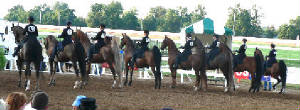
| The line up at Lexington during the Senior |
|
| Equitation Championship |
Be courteous at all times to fellow exhibitors, ring personnel, office workers, judges and the like. Sportsmanship is paramount
in the field of equitation. Congratulate the winners. Your time will come someday and you would want the same courtesy extended
to you. Also, be helpful to your fellow exhibitors. Point out in a tactful manner that their jod strap is undone or that their
horse has slobbered on their chaps, etc.
Subtle verbal communication between rider and horse is encouraged in equitation classes; however, this communication should
not be so loud as to be distracting to other exhibitors or ring personnel. A notable exception to this is when a rider is
specifically addressing another rider, such as calling "rail." However, excessive yelling of "rail, rail" is very distracting
and undignified and should be discouraged. The only time "rail" is appropriate is when another rider is cutting in dangerously
close and collision is imminent. It is inappropriate for a rider to come up behind a rider already on the rail and force them
off the rail. Riders should always be positioned so that they can go around those ahead of them, and should be penalized at
the judge's discretion for not doing so.
Leave room in the lineup for the nervous horse or rider. In addition to being courteous and safety-conscious, this will
lessen the effect that horse might have on your mount.
Show disciplined control of your mount, but never abuse it if it makes a mistake, either in the ring or after leaving the
ring. The show arena and grounds are not proper places to "teach the horse a lesson." Emotions run high and a lot is a stake,
and because of this most mistakes are due to rider error for which the horse should not be punished.
Do not wear anything or put anything on the horse or rider that jiggles, flaps, or waves. This includes loose hair or hair
ribbons, flapping ties or fringe and unpinned numbers. All of these are very distracting to the judge, especially not being
able to read a rider's number. If a rider trims their number card, care should be taken to not reduce the size so that the
judge can easily read the number. Pinning numbers both top and bottom as well as from inside the shirt or jacket will make
a smoother picture.
Riders should enter the arena ready to show, displaying confidence and presence. Show that you are a rider and not just
a passenger. Poise and consistency, even under adverse conditions, are necessary. Perfect the performance of your horse to
best reflect your equitation abilities. A ground-covering smooth walk should not be so strong that its lateral movement creates
too much body motion in the rider. A smooth, cadenced trot will be much more attractive than a bone-jarring concussive gait.
Likewise, a smooth flowing canter will enhance a rider's skills rather than the four-beat gait that shakes or vibrates the
rider.
Position of Rider/Suitability of Horse
| Emily Buchanan and Mantic Top Gun |

|
| Morgan Equitation rider photo by Howie Schatzberg |
1. Maintaining
center of balance: Rider's back should be straight, with shoulders directly over hips and spine in line with that of horse.
Leaning down over horse to check leads and/or diagonals should be severely penalized. Ideally, a rider should be able to feel
the correct lead and diagonals, but if they must be checked, only a glance downward with the eyes is appropriate. However,
a rider who leans over and obtains a correct lead or diagonal should be scored above a rider who glances down but obtains
and maintains an incorrect lead or diagonal.
2. Hands:
Hands should be quiet and light, with flexible (not locked) wrists and should show sympathy, adaptability and control. Horses
with high-set necks allow the rider's hands to be held higher than do horses with low-set necks; therefore, the placement
of the horse's neck dictates the proper elevation of the rider's hands. Hands should be tipped in 30-45 degrees from vertical
and should not be excessively far apart (not more than 8 inches in most cases). Bight of reins is on off (right) side. Constant
bumping of the horse's mouth or excessive shortening of the reins is distracting and should be avoided.
3. Arms:
Elbows should be no further from the body than the point at which the chest begins to look concave. This is called "pumpkin
arms" or cave-chested because improper roundness of the arms forces the chest to cave inward and the shoulders to come forward
out of position. The upper body, including the arms and hands, should give the appearance of elegant style and complete control
but without the impression of stiffness, posing or exaggeration.
4. Legs
and Feet: The old days of the flared lower leg and cocked ankle are long gone. It is easy to see why, as this unnatural leg
and foot position did not allow the rider to properly guide the horse using calf pressure. With feet in stirrups, the stirrup
leathers should hang straight down, should never be twisted and should be even on both sides. With feet out of stirrups and
relaxed, proper length of irons may be determined by finding the point at which the stirrup touches the inside ankle bone.
A good rule of thumb is that the stirrup should hit close to or just below the ankle bone depending on the length of the rider's
leg.
5. Exhibitors
are reminded to always refer to the current USEF rule book for specific rules regarding Saddle Seat position and
suitability.
Attire of Rider/Tack of Horse
| Lindsay Haupt |

|
1.
Properly fitted, clean tack and clothing along with a well-groomed, neatly clipped horse go a long way toward perfecting the
ultimate final picture. Some judges have even been known to check the bottom of a rider's boots for cleanliness, so be prepared!
2. Informal saddle
suits must consist of a jacket of a conservative color
with matching jodhpurs, a collared shirt, tie,
vest, and complimentary gloves, jodhpur boots, and derby or soft hat (protective headgear may be worn without penalty per GR318.4). Conservative colors for informal riding habits include
black, blue, grey, burgundy, green, beige, or brown and may contain herringbone, pin stripes, and other combinations of colors
that appear solid. Colors not included in this list are not acceptable and shall be cause for elimination. An emerald green to fire-engine red derby may match your vest, but is definitely not conservative and
should be avoided. This also applies to contrasting hat bands and gloves as well as derbies. A safe rule of thumb to follow
is that if a contrasting derby is worn, it should be of the same color family as the riding habit or matching the boots and
gloves. Only informal dress is permitted in Saddlebred Pleasure Equitation classes, day or night. Day coats are not permitted. Effective 4/08
3. Even
more conservative attire is required for evening classes. Riding
habit will consist of tuxedo-type jacket with a shawl collar and lapel of the same color with matching jodhpurs, formal shirt, bow tie, vest or cummerbund, and matching top hat (women), homburg
or other soft hat (men). Solid colors for formal
riding habits include dark grey, dark brown, dark blue, or black. Formal shirt must be white or off-white with the bow tie
and vest or cummerbund to match shirt or riding
habit in color. There is no allowance in formal attire for contrasting colors. Colors not included in this list are not
acceptable and shall be cause for elimination. Formal riding habits are not to be worn
before 6:00 p.m. and are not mandatory after 6:00 p.m.; exhibitors competing on Pleasure horses have the option to wear formal
attire in Open equitation classes as specified by the rule. Also, either black/navy/dark
brown or white gloves are proper - but keep in mind that white gloves draw attention to the hands so make sure yours are very
good before you wear them. Finally, if earrings are worn, they should be small and also conservative. Small stud earrings
are more appropriate for formal than informal attire. Effective 4/08
4. Spurs, if worn, must be unrowelled and not so
large that they noticeably interfere with the smooth line of the jod pants. A whip or crop is optional, but if used should
be of an appropriate length. Courtesy of the USEF Rule Book
Saddleseat Equitation Official Rules (pg.11)
| Erin Sembler and A Touch of Pizzaz |

|
| American Royal Equitation Championship |
Formal Attire
| Amanda Arrick and Will Gillian Adult UPHA final |

|
| photo by Shiflet |
Informal Attire
Best Tack for the Equitation Rider
| Best All Around |

|
| Shivley MMX |
| Made Especially For the Eq rider |

|
| Shivley 2000 |
| Best Economically (many used) |

|
| Barnsby Regular or Eq seat with Adjustable Bars |
| Prussian (Stubben Style) Irons |

|
| Smaller and less heavy (compared to Fillis style irons) they produce a more polished look. |
| Black stirrup iron pads |

|
| Black pads attract less attention to the foot and produce a visually smoother line. |
|